

The process of food digestion in the human gastrointestinal tract (GIT) is a complex and multi-stage process, during which food is broken down into simpler components that can be absorbed by the body. This process involves mechanical crushing of food, chemical breakdown by enzymesEnzymes are proteins that accelerate chemical reactions in the body. They ensure the occurrence of metabolic processes such as food digestion, energy release, cell formation, and many others., and absorption of nutrients. Let’s take a step-by-step look at this process, starting from the moment food enters the mouth and ending with its removal from the body.
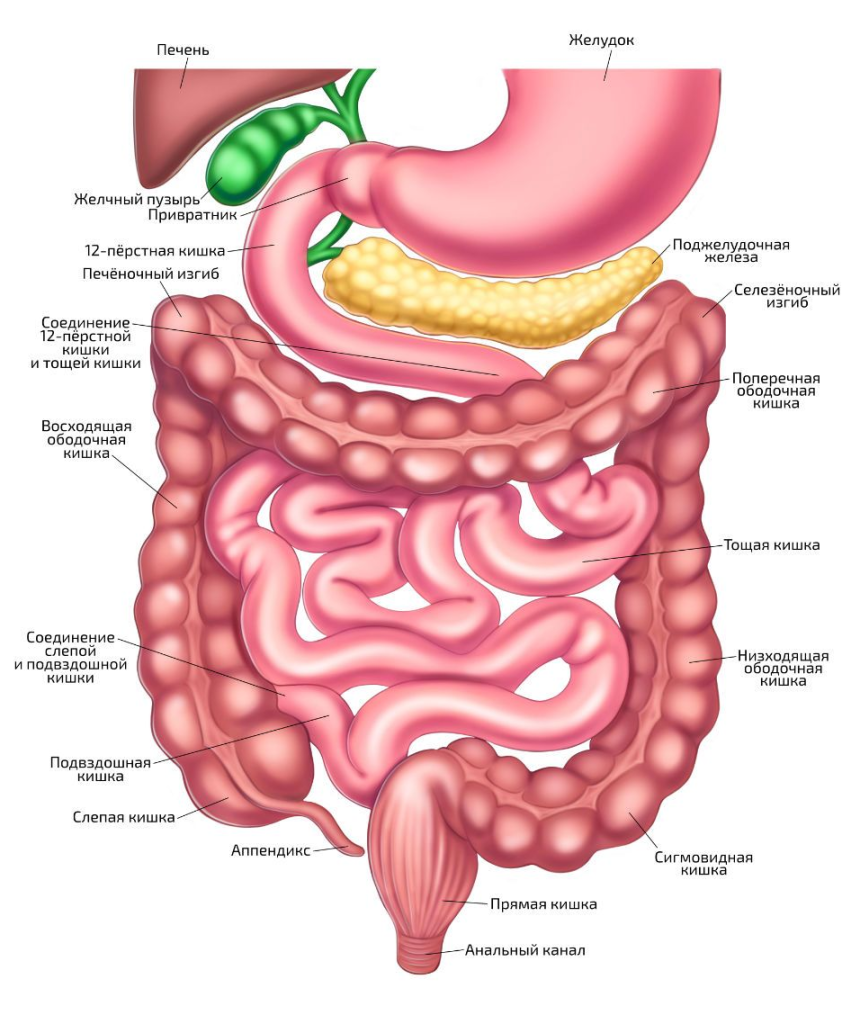
1. Oral cavity (mechanical and chemical treatment):
- Mechanical processing: The teeth grind food, and the tongue helps to mix it with saliva.
- Chemical treatment: Saliva contains the enzyme amylase, which breaks down carbohydrates (such as starch) into simpler sugars (maltose).
- The result: The food turns into a food lump (bolus) that is easily swallowed.
2. Esophagus (transport):
- A food lump passes through the esophagus due to peristalsis — wave-like contractions of the muscles of the esophageal walls.
- At this stage, food breakdown does not occur.
3. Stomach (mechanical and chemical treatment):
- Mechanical processing: The stomach walls contract, mixing food with gastric juice.
- Chemical treatment:
- Gastric juice contains hydrochloric acid (HCl), which creates an acidic environment (pH ~1-2) necessary for activating enzymes and killing bacteria.
- The enzyme pepsin breaks down proteinsProteins are high-molecular organic substances consisting of alpha-amino acids linked in a chain by a peptide bond. In living organisms, the amino acid composition of proteins is determined by the genetic code. During synthesis, 20 standard amino acids are used in most cases. Many combinations of them determine the great diversity of properties of protein molecules. Proteins play a key role in the immune response and can perform transport, storage, catalytic, structural, and receptor functions. Proteins are an important part of the nutrition of animals and humans. The main sources of proteins are meat, poultry, fish, milk, nuts, legumes, and grains. into shorter peptides.
- Gastric lipase begins to break down fat, but its role here is minimal.
- The result: The food turns into a semi-liquid mass called chyme.
4. Small intestine (basic digestion and absorption):
The small intestine consists of three parts: the duodenum, jejunum, and ileum. This is where the main breakdown and absorption of nutrients takes place.
- The duodenum:
- Here comes chyme from the stomach.
- The pancreas secretes pancreatic juice containing enzymes:
- Amylase -continues to break down carbohydrates.
- Lipase -breaks down fats into glycerol and fatty acids.
- ProteasesProteases are enzymes that break down proteins. (trypsin, chymotrypsin) — break down proteins into amino acidsAmino acids are the fundamental building blocks of proteins and play a key role in biological processes. There are a total of 22 standard amino acids used for protein synthesis in living organisms..
- Bile produced by the liver and stored in the gallbladder emulsifies fats, facilitating their breakdown by lipase.
- Jejunum and Ileum:
- Here, nutrients are absorbed through the intestinal walls into the blood and lymph.
- Carbohydrates are absorbed as monosaccharides (glucose, fructose).
- Proteins are absorbed as amino acids.
- Fats are absorbed as fatty acids and monoglycerides, which are then converted to lipoproteins and transported through the lymphatic system.
5. Large intestine (water absorption and stool formation):
- In the large intestine, water, electrolytes, and certain vitamins (such as B and K vitamins produced by the intestinal microflora) are absorbed.
- Food residues that have not been digested and assimilated are compacted and formed into fecal masses.
- The microflora of the large intestine plays an important role in the fermentation of undigested carbohydrates and the synthesis of certain vitamins.
6. Rectum and anus (excretion):
- Feces accumulate in the rectum.
- Through the anus, fecal matter is removed from the body.
Basic enzymes and their role in food breakdown:
- Carbohydrates:
- Amylase (saliva, pancreas) → maltose.
- Maltase, sucrose, lactase (small intestine) → glucose, fructose, galactose.
- Squirrels:
- Pepsin (stomach) → peptides.
- Trypsin, chymotrypsin (pancreas) → amino acids.
- Fats:
- Lipase (pancreas) → glycerol + fatty acids.
- Bile (emulsification of fats).
Conclusion
The process of food digestion in the gastrointestinal tract is a well-coordinated work of mechanical and chemical processes involving enzymes, acids, bile and microflora. Each step plays an important role in converting food into nutrients that can be absorbed by the body. Disruption of any of the steps can lead to problems with digestion and nutrient absorption.