The role of testosterone in the body
Testosterone is the main male sex hormone (androgen), although it is also present in women. It plays a key role in:
For men:
- Development of primary and secondary sexual characteristics (growth of the genitals, male-type hair, low voice).
- Spermatogenesis (formation of spermatozoa).
- Increase in muscle mass and strength.
- Fat distribution (less subcutaneous fat).
- Maintaining libido and erectile function.
- Influence on mood, energy, and cognitive functions.
- Strengthening of bone tissue.
For women:
- Maintaining libido.
- Regulation of muscle mass and strength.
- Influence on mood and energy.
- Participation in ovarian function.
Symptoms of testosterone deficiency (hypogonadism)
For men:
- Decreased libido and erectile dysfunction.
- Reduced muscle mass and strength.
- Increased body fat (especially in the abdominal area).
- Fatigue, depression, irritability.
- Reducing the growth of facial and body hair.
- Gynecomastia (breast augmentation).
- Osteoporosis (reduced bone density).
- Hot flashes, sweating.
- Reduced testicular volume.
For women:
- Decreased sexual desire.
- Chronic fatigue.
- Depression, mood swings.
- Reduced muscle tone.
Symptoms of excess testosterone
For men:
- Increased aggressiveness, irritability.
- Acne.
- Male pattern baldness.
- Increased hematocrit (risk of thrombosis).
- Enlarged prostate (risk of adenoma).
- Infertility (due to suppression of spermatogenesis at high doses).
For women:
- Hirsutism (excessive hair growth on the face and body).
- Acne, oily skin.
- Violation of the menstrual cycle.
- Voice coarsening.
- Clitoral enlargement.
- Androgenetic alopecia (male pattern baldness).
The norm of testosterone in the blood
| Group | Total Testosterone (nmol / l) | Free Testosterone (pmol / l) |
|---|---|---|
| Men | 8,64 – 29,0 | 50 – 210 |
| Women | 0,29 – 1,67 | 1 – 10 |
Note: The reference values may vary depending on the laboratory.
Important points:
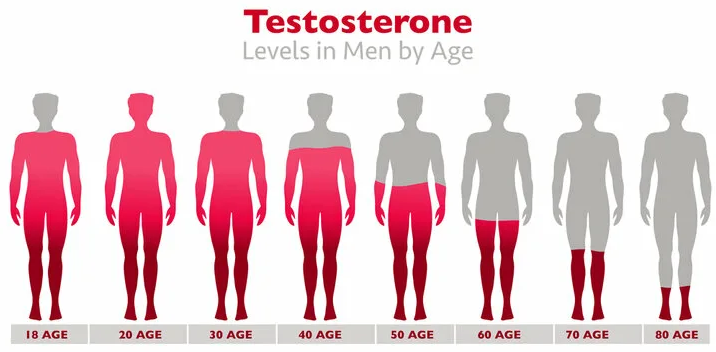
- In men, the level of testosterone decreases with age (after 30 years-about 1% per year).
- In women, the level changes during the cycle (maximum at ovulation).
- It is better to take the analysis in the morning (peak secretion – 7-9 am).
If an imbalance is suspected, you should also check LH, FSH, prolactin, SHBG, and estradiol.