
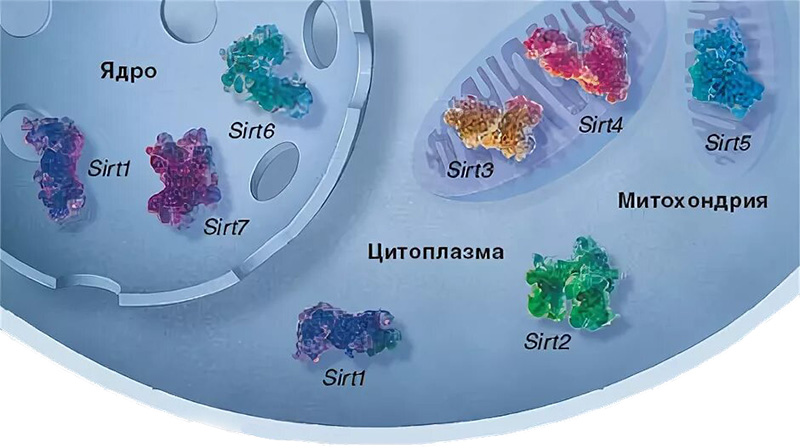
Sirtuins are a family of NAD+ – dependent deacetylases and ADP-ribosyltransferases that play a key role in regulating cellular metabolism, repairing DNA, protecting against stress, and prolonging cell life. They are considered important players in the aging and longevity processes. Activation of sirtuins can have a positive effect on health, slowing down age-related changes and reducing the risk of chronic diseases.
Main functions of sirtuins:
- Regulation of metabolism:
- Sirtuins are involved in energy balance control by regulating the processes of gluconeogenesis, lipolysis, and fatty acid oxidation.
- Protecting your DNA:
- Sirtuins help repair DNA damage and maintain genome stability.
- Antioxidant protection:
- They activate genes associated with protection against oxidative stress.
- Anti-inflammatory effect:
- Sirtuins suppress inflammatory processes, which is important for the prevention of age-related diseases.
- Regulation of circadian rhythms:
- Sirtuins affect the biological clock, improving the body’s adaptation to environmental changes.
- Maintaining cellular homeostasis:
- They are involved in the processes of autophagy (utilization of damaged cellular components) and apoptosis (programmed cell death).
Ways to activate sirtuins:
Sirtuin activation can occur through a variety of mechanisms, including changes in NAD+ levels, use of natural compounds, physical activity, and calorie restriction.
1. Increasing the NAD+level:
- NAD+ (nicotinamide adenine dinucleotide) is a coenzyme essential for sirtuin activity. With age, the NAD+ level decreases, which leads to a decrease in sirtuin activity. Ways to increase NAD+:
- Receiving NAD + precursors:
- Nicotinamide riboside (NR) and nicotinamide mononucleotide (NMN) are supplements that are converted to NAD+ in the body.
- A diet rich in tryptophan and vitamin B3:
- Foods such as meat, fish, nuts, and seeds contain NAD + precursors.
- Physical activity:
- Exercise increases NAD+ levels and activates sirtuins.
- Receiving NAD + precursors:
2. Calorie restriction (caloric restriction):
- Limiting your calorie intake without being deficient in nutrients is one of the most effective ways to activate sirtuins. This is due to an increase in NAD+ levels and a decrease in sirtuin inhibitors such as nicotinamide.
- Intermittent fasting:
- Diet modes such as 16/8 (16 hours of fasting and 8 hours of eating) can also activate sirtuins.
3. Natural Sirtuin Activators:
- Some natural compounds can directly or indirectly activate sirtuins:
- Resveratrol:
- A polyphenol found in red wine, grapes, and berries activates SIRT1.
- Quercetin:
- The flavonoid found in apples, onions, and berries also helps activate sirtuins.
- Fizitin:
- Another flavonoid that activates sirtuins and promotes cellular health.
- Curcumin:
- The active ingredient of turmeric, which has anti-inflammatory and antioxidant properties.
- Resveratrol:
4. Physical activity:
- Regular exercise, especially aerobic and strength training, increases NAD+ levels and activates sirtuins. This helps improve your metabolism, protect your DNA, and slow down aging.
5. Reduced levels of sirtuin inhibitors:
- Nicotinamide (a form of vitamin B3) is a product of the deacetylation reaction catalyzed by sirtuins and can inhibit their activity. Reducing nicotinamide levels may increase the activity of sirtuins.
6. Genetic and pharmacological approaches:
- Genetic activation:
- Animal studies have shown that increasing the expression of sirtuin genes (such as SIRT1 or SIRT6) can prolong life and improve health.
- Pharmacological activators:
- Drugs that can specifically activate sirtuins, such as SRT1720 (SIRT1 activator), are being developed.
Practical recommendations for activating sirtuins:
- A balanced diet:
- Include foods rich in resveratrol, quercetin, curcumin, and other polyphenolsPolyphenols are a group of natural organic compounds that contain several phenolic groups (aromatic rings with hydroxyl groups -OH). They are widely distributed in plants and play an important role in their protection from ultraviolet radiation, pathogens, and oxidative stress. in your diet.
- Intermittent fasting:
- Try eating routines like 16/8 or 5:2 (5 days of normal nutrition and 2 days of calorie restriction).
- Regular training sessions:
- Do aerobic and strength training at least 3-4 times a week.
- Taking supplements:
- Consider taking NMN, NR, or resveratrol after consulting your doctor.
- Reducing stress:
- Practice meditation, yoga, or other stress-reducing techniques, as chronic stress can reduce sirtuin activity.
The concentration and activity of sirtuin proteinsProteins are high-molecular organic substances consisting of alpha-amino acids linked in a chain by a peptide bond. In living organisms, the amino acid composition of proteins is determined by the genetic code. During synthesis, 20 standard amino acids are used in most cases. Many combinations of them determine the great diversity of properties of protein molecules. Proteins play a key role in the immune response and can perform transport, storage, catalytic, structural, and receptor functions. Proteins are an important part of the nutrition of animals and humans. The main sources of proteins are meat, poultry, fish, milk, nuts, legumes, and grains. vary from one organism to another, and their role in longevity and stress resistance is being studied in various models. Some organisms show a high concentration or activity of sirtuins, which is associated with their unique adaptations to the environment and life expectancy. Here are some examples::
Naked mole rat (Heterocephalus glaber):
- Naked mole rats are unique rodents known for their exceptional life expectancy (up to 30 years) and cancer resistance.
- They showed high activity of sirtuins, especially SIRT6, which plays a key role in maintaining genome stability and protecting against age-related diseases.
Long-lived marine organisms:
- Some marine organisms, such as the hydra and the clam Arctica islandica, show exceptional longevity and resistance to aging.
- In these organisms, sirtuins play an important role in maintaining cellular homeostasis and tissue regeneration.