Goal. Despite numerous studies on the ability of various molecules to destroy Glycation End Products (AGES-Advanced Glycation EndProducts), none of them, as far as we know, evaluated the ability to destroy pathological cross-links within and between protein molecules. The aim of this work was to clearly show ribose-induced polymerization of albuminOne of the main proteins of the human body, responsible for maintaining normal blood composition and transporting various substances throughout the body. It also serves as a reserve source of amino acids. Albumins perform two very important functions: managing the distribution of water within the body, helping the blood transport vitamins, minerals, and medications. They are responsible for water exchange — they help retain it in the vessels and prevent it from excessively moving into the tissues (thus preventing the development of edema). Albumins influence the formation of tissue fluid, urine, and lymph, and also control the process of water absorption from the intestines., and then the ability of polyphenolic acid extracted from rosemary (Rosmarinus officinalis) and rosmarinic acid to break down pre-formed albumin polymers.
Methods. Albumin was glycated by incubation with ribose, and the resulting protein polymers were evaluated by gel-size exclusion chromatography (GC) and fluorometry. After ribose elimination by dialysis, the proteinsProteins are high-molecular organic substances consisting of alpha-amino acids linked in a chain by a peptide bond. In living organisms, the amino acid composition of proteins is determined by the genetic code. During synthesis, 20 standard amino acids are used in most cases. Many combinations of them determine the great diversity of properties of protein molecules. Proteins play a key role in the immune response and can perform transport, storage, catalytic, structural, and receptor functions. Proteins are an important part of the nutrition of animals and humans. The main sources of proteins are meat, poultry, fish, milk, nuts, legumes, and grains. were treated with rosmarinic acid, aminoguanidine, carnosine, and Alagebrium (ALT-711; Alteon) as a positive control. The degree of deglycation was determined by the ratio of the amounts of polymerized and native albumin-before and after treatment with deglycing molecules.
Results. Rosmarinic acid has been shown to destroy formed cross-links as effectively as Alagebrium. In contrast, aminoguanidine and carnosine, inhibitors of the glycation reaction, did not significantly reverse the polymerization of albumin.
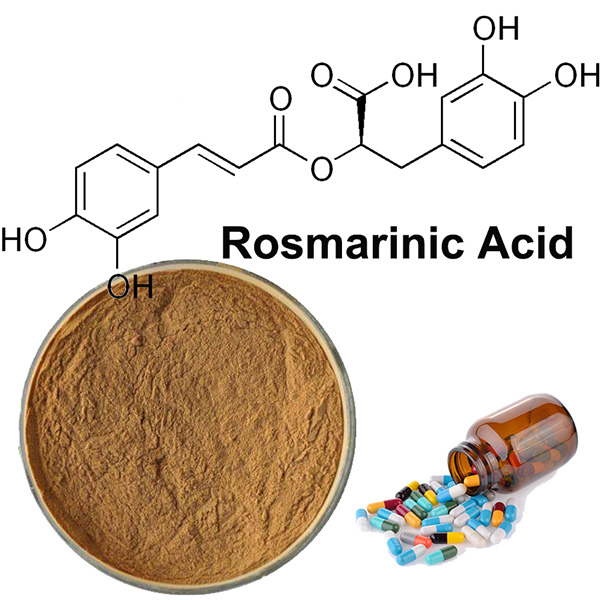
Rosmarinic acid is a natural compound belonging to the class of polyphenolsPolyphenols are a group of natural organic compounds that contain several phenolic groups (aromatic rings with hydroxyl groups -OH). They are widely distributed in plants and play an important role in their protection from ultraviolet radiation, pathogens, and oxidative stress.. It is widely distributed in plants and is known for its powerful antioxidant, anti-inflammatory, antimicrobial and other biologically active properties. Rosmarinic acid was first isolated from the rosemary plant (Rosmarinus officinalis), from which it gets its name, but is also found in many other plants such as lemon balm, sage, mint, basil, and thyme.
Rosmarinic acid is an ester formed from two phenolic compounds: caffeic acid and 3,4-dihydroxyphenylmolk acid. Its chemical formula is CHh₁₆o₈. The structure includes:
Rosmarinic acid is found in many plants, especially in the Labiaceae family. Main sources:
Rosmarinic acid has a wide range of biological properties that make it a valuable compound for medicine, cosmetology and the food industry.
Rosemary acid is a powerful antioxidant that can neutralize free radicals and prevent oxidative stress. This is achieved by:
Rosemary acid suppresses inflammatory processes by:
Rosemary acid has antibacterial, antiviral and antifungal properties. She:
Rosemary acid protects neurons from damage caused by oxidative stress and inflammation. She:
Rosemary acid helps control blood sugar levels by::
Rosemary acid protects the cardiovascular system by:
Rosemary acid is used in cosmetology for:
Rosemary acid is considered a safe compound when consumed in moderation. However, in high doses, it can cause:
Rosmarinic acid is a multifunctional compound with a wide range of biological activity. Its antioxidant, anti-inflammatory, antimicrobial and neuroprotective properties make it a valuable component for medicine, cosmetology and the food industry. Research continues to reveal new applications of this unique polyphenol to improve health and quality of life.