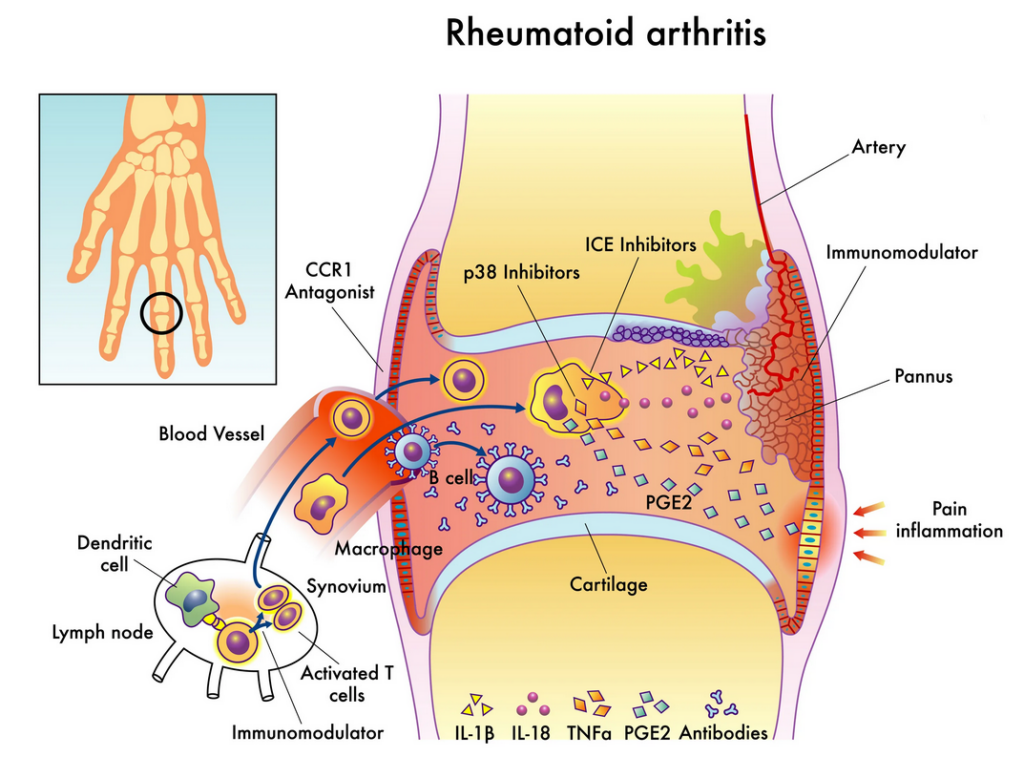
The role of rheumatoid factor (RF) in the body
Rheumatoid factor (RF) is an autoantibody (usually IgM, rarely IgG or IgA) that mistakenly attacks its own immunoglobulins G (IgG). Its main functions are:
- Marker of autoimmune processes:
- Binds to the Fc fragment of IgG, forming immune complexes that provoke inflammation.
- It is involved in the pathogenesis of rheumatoid arthritis (RA):
- It damages joints, blood vessels, and other tissues.
- It may be present normally (in 2-5% of healthy people, especially the elderly).
Norm of rheumatoid factor in the blood
| Assay Method | Normal Range (IU/ml) |
|---|---|
| ELISA/Nephelometry | < 14–20 |
| Latex Test | < 1:40 (titer) |
Interpretation:
- Increased RF:
- > 20 IU / ml – suspected autoimmune disease.
- > 50 IU / ml – high probability of RA or other systemic diseases.
- False positive results are possible for infections (hepatitis, tuberculosis).
Increased rheumatoid factor
Reasons:
- Autoimmune diseases:
- Rheumatoid arthritis (60-80% of patients).
- Sjogren ‘s syndrome(75-95%).
- SLE (systemic lupus erythematosus, 15-30%).
- Infections:
- Hepatitis B / C, endocarditis, tuberculosis.
- Other states:
- Sarcoidosis, cirrhosis of the liver.
Symptoms (depending on the disease):
- With RA:
- Morning joint stiffness > 30 min.
- Pain in small joints (hands, feet).
- Late-stage joint deformities.
- For Sjogren’s syndrome:
- Dry eyes and mouth.
- Joint pain.
Reduced rheumatoid factor
RF deficiency is not a pathology and does not cause symptoms.
- In healthy people, RF may be absent.
- Seronegative rheumatoid arthritis (20-30% of patients with RA do not have RF).
How do I normalize the level?
With increased RF:
- Treatment of the underlying disease:
- RA: methotrexate, biologics (infliximab).
- Sjogren‘s syndrome: immunosuppressants, artificial tears.
- Control of inflammation:
- NSAIDs (ibuprofen – – for pain relief.
- Glucocorticoids (prednisone) – for severe inflammation.
In the absence of RF, but with RA symptoms:
- They check for anti-CCP (ACPA) , a more specific marker of RA.
When should I take the test?
- For pain and swelling of the joints.
- For dry eyes/mouth (suspected Sjogren).
- For differential diagnosis of autoimmune diseases.
Important:
- RF is not a 100% confirmation of RA – a complex of tests is needed (anti-CCP, CRP, X-ray of joints).
- In children, RF is more often associated with infections, rather than with autoimmune processes.
Example:
RF 60 IU / ml + anti-CCP (+) + symmetric arthritis → diagnosis of rheumatoid arthritis.