
Lactate Dehydrogenase

Lactate dehydrogenase (LDH) – role in the body

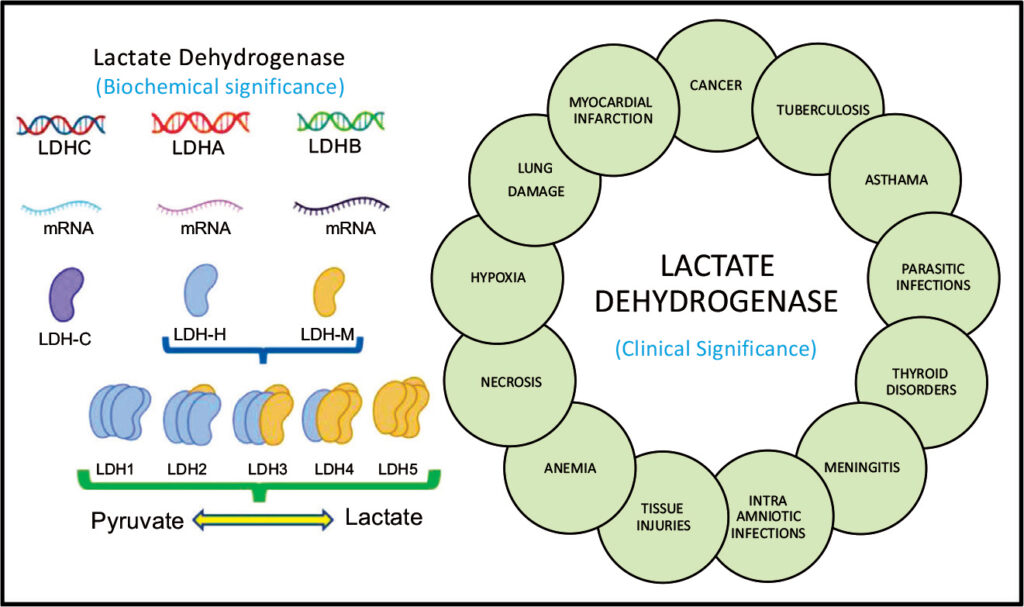
LDH is a key enzyme involved in the energy metabolism of cells. It catalyzes the conversion of lactate to pyruvate (and vice versa) during glycolysis.

Main functions of LDH:

  1. Providing oxygen-free (anaerobic) glucose metabolism
  2. Maintaining energy balance in hypoxic conditions
  3. Participation in muscle work (especially during intense exercise)
  4. Indicator of cellular damage (LDH is released into the blood when cells are destroyed)

LDH isoenzymes and their localization:

  • LDH-1, LDH-2: heart, red blood cells, kidneys
  • LDH-3: lungs, lymph nodes, platelets
  • LDH-4, LDH-5: Liver, skeletal muscle

LDH norm in the blood test

Age GroupNormal LDH (U/L)
Adults125-220
Newborns220-600
Children under 2 years115-450
Children 2-12 years115-300
Adolescents100-290

Reference values (may vary from laboratory to laboratory):

Note: Athletes may have higher-than-average LDH levels.


Symptoms of excessive LDH (elevated levels)

An increase in LDH indicates massive cell destruction:

  1. In case of heart damage (myocardial infarction):
  • Severe retrosternal pain
  • Shortness of breath
  • Cold sweat
  1. For liver diseases:
  • Nausea, weakness
  • Jaundice
  • Heaviness in the right hypochondrium
  1. With hemolytic anemia:
  • Paleness
  • Weakness
  • Yellowness
  1. In case of lung damage:
  • Shortness of breath
  • Cough
  • Hemoptysis (with PE)
  1. For muscle injuries:
  • Muscle aches
  • Weakness
  • Puffiness

LDH deficiency (reduced level)

It is extremely rare. May be related to:

  • Genetic disorders
  • Taking vitamin C in large doses
  • Uremia (in CRF)

Symptoms:

  • Rapid fatigue
  • Muscle weakness
  • Physical activity intolerance

Reasons for changing LDH levels

Increase (main reasons):

  1. Myocardial infarction (LDH-1)
  2. Hemolytic anemia
  3. Liver diseases (hepatitis, cirrhosis)
  4. Muscle injuries
  5. Malignant neoplasms
  6. Pulmonary embolism
  7. Shock states
  8. Megaloblastic anemia

Downgrade:

  1. Genetic defects
  2. Excess vitamin C
  3. Uremia

Diagnostic value of LDH isoenzymes


What should I do in case of LDH deviations?

With increased LDH:

  1. Determine the isoenzyme composition
  2. Perform additional diagnostics:
  • ECG, troponins (if a heart attack is suspected)
  • Ultrasound of the liver, liver tests
  • General blood test (exclude anemia)
  • Creatine Kinase (for muscle damage)

With low LDH:
It usually doesn’t require treatment, but it’s worth it:
  • Exclude genetic pathologies
  • Adjust your vitamin C intake

Conclusions

  • LDH is a marker of cellular damage
  • Norm: 125-220 U/l for adults
  • An increase indicates a heart attack, anemia, hepatitis, or muscle injury.
  • Downgrades are rare and usually not significant
  • Determination of isoenzymes helps to clarify the localization of damage