Krebs cycle – Main function, stages, meaning

The Krebs cycle (also known as the tricarboxylic acid cycle or citric acidcycle) is a key metabolic pathway that plays a central role in cellular respiration and energy metabolism. It occurs in the mitochondria of eukaryotic cells and is the main source of energy for most living organisms. The Krebs cycle was discovered by German biochemist Hans Krebs in 1937, for which he received the Nobel Prize in Physiology or Medicine in 1953.


Basic function of the Krebs cycle

The Krebs cycle performs several important functions:

  1. Power generation:
    • During the cycle, energy transfer molecules (NADH and fadh₂) are formed, which are then used in the respiratory chain to synthesize ATP (adenosine triphosphate) — the main energy ‘currency’ of the cell.
  2. Synthesis of precursors:
    • The Krebs cycle supplies intermediates for the synthesis of amino acids, fatty acids, glucose, and other important molecules.
  3. Nutrient oxidation:
    • In the cycle, acetyl-CoA (derived from carbohydrates, fats and proteins) is oxidized to carbon dioxide (co₂) with the release of energy.

Stages of the Krebs cycle

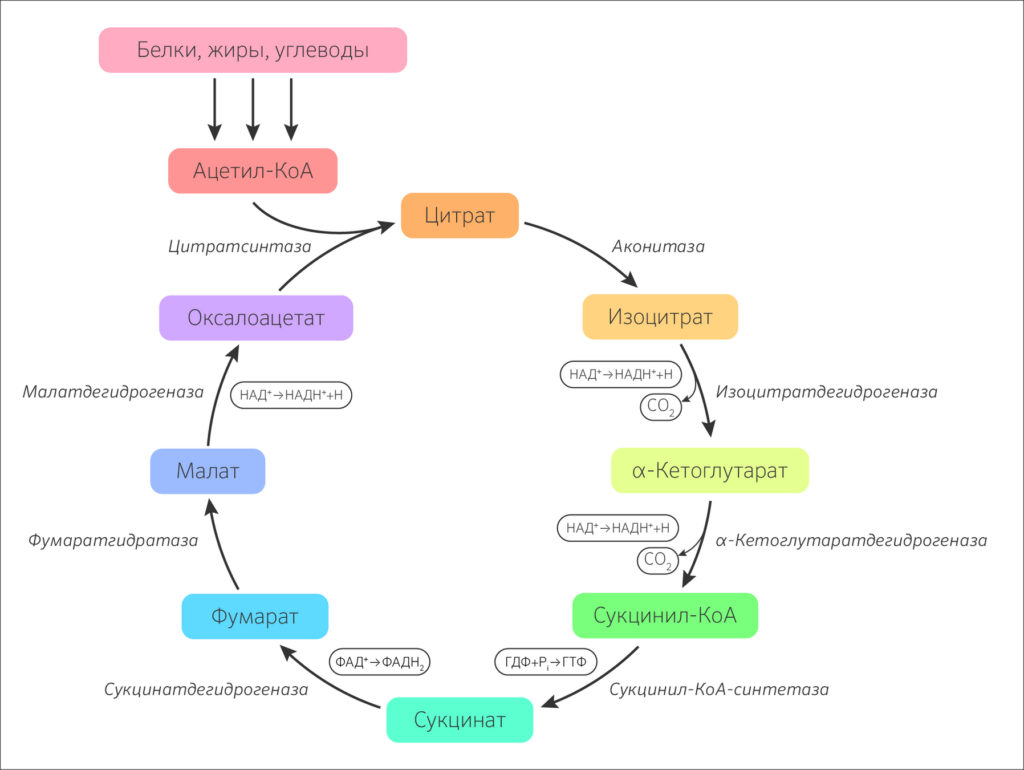
The Krebs cycle consists of 8 main steps, each of which is catalyzed by a specific enzyme. Here is a brief description of each stage:

  1. Citrate formation:
    • Acetyl-CoA (2-carbon compound) combines with oxaloacetate (4-carbon compound) to form citrate (6-carbon compound). It is catalyzed by the enzyme citrate synthase.
  2. Isomerization of citrate to isocitrate:
    • Citrate is converted to isocitrate through an intermediate called cis-aconitate. It is catalyzed by the enzyme aconitase.
  3. Oxidation of isocitrate to alpha-ketoglutarate:
    • Isocitrate is oxidized to α-ketoglutarate (5-carbon compound) with the release of co₂ and the formation of NADH. It is catalyzed by the enzyme isocitrate dehydrogenase.
  4. Oxidation of alpha-ketoglutarate to succinyl-CoA:
    • alpha-ketoglutarate is oxidized to succinyl-CoA with the release of co₂ and the formation of NADH. It is catalyzed by the enzyme α-ketoglutarate dehydrogenase.
  5. Conversion of succinyl-CoA to succinate:
    • Succinyl-CoA is converted to succinate (a 4-carbon compound) to form GTP (an analog of ATP). It is catalyzed by the enzyme succinyl-CoA synthetase.
  6. Oxidation of succinate to fumarate:
    • Succinate is oxidized to fumarate to form FADH₂. It is catalyzed by the enzyme succinate dehydrogenase.
  7. Hydration of fumarate to malate:
    • The fumarate is hydrated to malate. It is catalyzed by the enzyme fumarase.
  8. Oxidation of malate to oxaloacetate:
    • Malate is oxidized to oxaloacetate to form NADH. It is catalyzed by the enzymemalate dehydrogenase.

Energy output of the Krebs cycle

For one full Krebs cycle:

  • 3 NADH molecules and 1 fadh₂ molecule areformed, which are then used in the respiratory chain to synthesize ATP.
  • 1 GTP molecule is formed (equivalent to 1 ATP molecule).
  • 2 molecules of co₂ (oxidation product) are released.

In the respiratory chain, NADH and fadh₂ generate:

  • 1 NADH → ~2.5-3 ATP.
  • 1 FADH → → ~1.5-2 ATP.

Thus, the total energy output from one Krebs cycle is about 10-12 ATP molecules.


Regulation of the Krebs cycle

The Krebs cycle is regulated at several levels:

  1. Substrate concentration:
    • The availability of acetyl-CoA and oxaloacetate affects the cycle rate.
  2. Allosteric regulation:
    • Cycle enzymes are regulated by the concentration of ATP, ADP, NADH, and other molecules. For example, high levels of ATP inhibit the cycle, while high levels of ADP activate it.
  3. Hormone regulation:
    • Hormones such as insulin and glucagon affect the activity of cycle enzymes.

Meaning of the Krebs cycle

  1. Energy field:
    • The Krebs cycle is the main source of energy for cells, especially in aerobic conditions.
  2. Anabolic:
    • Intermediates of the cycle are used to synthesize amino acids, nucleotides, and other important molecules.
  3. Catabolic:
    • The cycle completes the oxidation of carbohydrates, fats, and proteins to co₂ and water.

Conclusion

The Krebs cycle is a fundamental process that links catabolism (breakdown of nutrients) with anabolism (synthesis of new molecules) and provides the cell with energy. Understanding it is important for studying biochemistry, medicine, and biology in general.