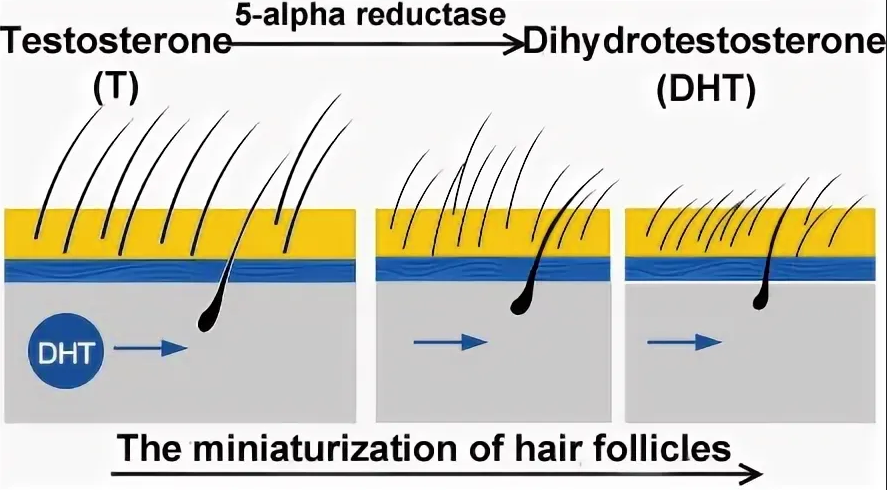
Dehydrotestosterone (DHT)

The role of dehydrotestosterone (DHT) in the body

Dehydrotestosterone (DHT) is an active metabolite of testosteroneproduced by the enzyme 5– alpha reductase. . It binds to androgen receptors 3-10 times more strongly than testosterone, and plays a key role in:

  1. Sexual development in men:
  • Formation of external genitalia in the fetus.
  • Growth of the prostate, seminal vesicles.
  • Development of secondary sexual characteristics (hair, voice).
  1. For women:
  • Regulation of pubic and armpit hair growth.
  • Affects the work of the sebaceous glands (in excess – acne, hirsutism).
  1. Hair and skin:
  • Control of beard and moustache growth in men.
  • In excess – androgenetic alopecia (male pattern baldness).
  1. The prostate:
  • Stimulates the growth of the gland (with hyperplasia-DHT accelerates the process).

DHT tests

The level of DHT is measured in the blood (less often-in tissues).

Type of analysisStandards (depending on the laboratory)
Men250-990 pg / ml (0.25-0.99 ng / ml)
Women24-450 pg / ml (0.024-0.45 ng / ml)
Children (up to puberty)< 50 pg / ml

Note:

  • In men, DHT peaks in their 20s and 30s, then decreases.
  • In women, the level depends on the phase of the cycle (higher in the luteal phase).

Symptoms of DHT deficiency

A rare condition, most often associated with a genetic defect in 5-alpha reductase.

For men:

  • Underdevelopment of the genitals (micropenis, hypospadias).
  • Weak growth of beard and moustache.
  • Lack of androgenetic alopecia (do not go bald).
  • Infertility (rare).

For women:

  • Scanty pubic/underarmhair.
  • Dry skin (due to reduced sebaceous gland activity).

Reasons:

  • Congenital 5-alpha reductase deficiency.
  • Taking 5-alpha reductase inhibitors (finasteride, dutasteride).

Symptoms of excess DHT

For men:

  • Androgenetic alopecia (receding hairline, baldness of the crown).
  • Prostate hyperplasia (frequent urination).
  • Aggressiveness, increased libido (rarely).

For women:

  • Hirsutism (hair growth on the face, chest).
  • Acne, oily skin.
  • Androgenetic alopecia (thinning of hair on the temples).
  • Cycle disorders, infertility (with PCOS).

Reasons:

  • Hyperandrogenism (PCOS, ovarian/adrenal tumors).
  • Taking anabolic steroids.
  • Idiopathic hypersensitivity of the receptors (even with normal DHT).

How to normalize DHT levels?

If there is an excess:

  1. 5-alpha reductase blockers:
  • Finasteride (Propecia) – reduces DHT by 60-70%.
  • Dutasteride (Avodart) – blocks both types of enzymes.
  1. Antiandrogens (for women):
  • Spironolactone, ciproterone acetate.
  1. Natural remedies:
  • Palmetto (Serenoa repens) is a weak inhibitor of 5-alpha reductase.
  • Curcumin, green tea (reduce inflammation).

If there is a shortage:

  • In men – testosterone replacement therapy (partially converted to DHT).

When is the test scheduled?

  1. Men:
  • Early baldness (up to 30 years).
  • Prostatic hyperplasia.
  1. Women:
  • Hirsutism, acne.
  • Suspected PCOS.

Conclusion

  • DHT is a powerful androgen that affects hair, prostate, and sexual development.
  • Standards:
  • Men: 250-990 pg / ml.
  • Women: 24-450 pg / ml.
  • Deficiency is rare (in cases of genetic disorders).
  • Too much leads to baldness, hirsutism, and prostate problems.

Example: If a woman has DHT &> 500 pg / ml + hirsutism – PCOS or adrenal tumor should be excluded.