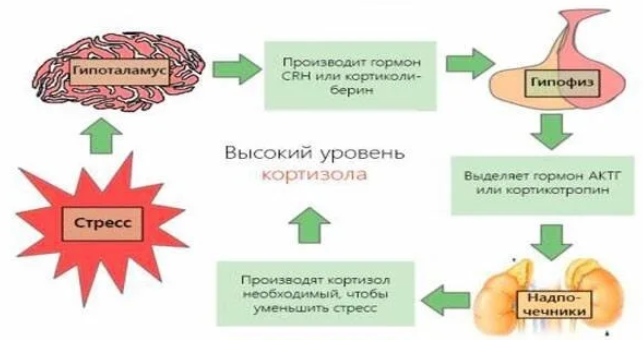
The role of cortisol in the body
Cortisol is a stress hormone produced by the adrenal cortex under the control of the hypothalamic-pituitary system ( HPA axis: hypothalamus → ACTH → adrenalglands).
Main functions:
- Regulation of metabolism:
- Increases the level of glucose in the blood (stimulates gluconeogenesis in the liver).
- Reduces glucose uptake by cells (an insulin antagonist).
- Promotes protein breakdown (catabolic effect).
- It affects lipolysis (fat breakdown).
- Anti-inflammatory and immunosuppressive effects:
- Suppresses immune responses (used in medicine to treat autoimmune diseases).
- Stress response:
- Mobilizes the body in critical situations (increases blood pressure, increases heart function).
- Impact on the central nervous system:
- May cause anxiety, insomnia in excess.
- Regulation of the water-salt balance:
- Weak mineralocorticoid effect (sodium and water retention).
Symptoms of cortisol deficiency (hypocorticism)
Reasons:
- Addison’s disease (primary adrenal insufficiency).
- Secondary insufficiency (pituitary/hypothalamic problems).
- Abrupt withdrawal of glucocorticoids after prolonged use.
Symptoms:
- Chronic fatigue, weakness.
- Hypoglycemia (dizziness, trembling, sweating).
- Weight loss, decreased appetite.
- Hyperpigmentation of the skin (in Addison’s disease).
- Low blood pressure (hypotension), fainting spells.
- Nausea, vomiting, abdominal pain.
- Depression, irritability.
Acute deficiency (Addison’s crisis) is a dangerous condition!
- Sudden drop in pressure, shock.
- Severe abdominal pain, vomiting.
- Loss of consciousness, possible death.
Symptoms of excess cortisol (hypercorticism)
Reasons:
- Cushing’s disease (pituitary adenoma that secretes ACTH).
- Cushing’s syndrome (a tumor of the adrenal glands or prolonged use of glucocorticoids).
- Functional hypercorticism (chronic stress, obesity, alcoholism).
Symptoms:
- Central obesity (belly fat, thin arms/legs).
- ‘Moon-shaped face’, ‘buffalo hump’ (deposition of fat on the neck).
- Stretch marks (striae) purple color on the stomach, thighs.
- Muscle weakness (due to protein catabolism).
- High blood pressure (hypertension).
- Osteoporosis (frequent fractures).
- Diabetes mellitus (steroid).
- Immune disorders (frequent infections).
- Depression, anxiety, insomnia.
- For women: violation of the cycle, hirsutism.
The norm of cortisol in the blood
Cortisol has a circadian rhythm of secretion:
- Maximum – in the morning (7-9 hours).
- Minimum – in the evening (after 22:00).
Reference values:
| Time of day | Cortisol (nmol / l) | Cortisol (mcg / dl) |
|---|---|---|
| Morning (7: 00-9: 00) | 138–690 | 5–25 |
| Evening (16: 00-20: 00) | <50% of the morning value | <10 |
Important:
- If a violation is suspected ,a daily salivatest, a daily urine test for cortisol or a desmopressin test are prescribed.
- In Cushing’s syndrome , the morning cortisol may be normal, but it does not decrease in the evening.
What should I do if there are deviations?
- In case of excess: Pituitary/adrenal MRI, ACTH test, dexamethasone test.
- In case of deficiency: ACTH-stimulation test, check of electrolytes (Na↓, K↑).
Treatment:
- Hypercorticism – surgery (removal of the tumor), cortisol synthesis blockers.
- Hypocorticism – lifelong replacement therapy (hydrocortisone).