
C-peptide: role in the body, symptoms of deficiency and excess, norms in the blood test
The role of C-peptide in the body
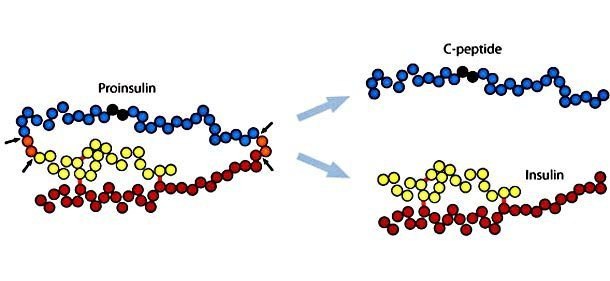
C-peptide (connective peptideA peptide is a molecule consisting of a chain of amino acids linked together by peptide bonds. Peptides are shorter chains than proteins and usually contain from 2 to 50 amino acids. When the number of amino acids in a chain exceeds 50, such molecules are called proteins. Peptides can perform various functions in the body, including: Hormones, Neuropeptides, Antibiotics, Antioxidants) is a fragment of the proinsulin moleculethat is broken off during the formation of insulin in the beta cells of the pancreas. .Its level reflects the insulin-producing ability of the pancreas.
Main functions:
- Marker of insulin synthesis (1 proinsulin molecule → 1 insulin molecule + 1 C-peptide molecule).
- It helps to distinguish self-produced insulin from externally administered insulin(exogenous insulin does not contain C-peptide).
- It is used to diagnose diabetes (especially if artificial hypoglycemia is suspected).
- Evaluates the residual function of beta cells in patients with type 1 and type 2 diabetes.
Symptoms of C-peptide deficiency
A low level indicates insufficient insulinproduction, which occurs when:
- Type 1 diabetes mellitus (autoimmune destruction of beta cells).
- Long-term type 2 diabetes (depletion of pancreatic reserves).
- Severe pancreatitis or removal of the pancreas.
Symptoms:
- Hyperglycemia (high blood sugar).
- Thirst, frequent urination.
- Weight loss, weakness (with type 1 diabetes).
- Ketoacidosis (with severe insulin deficiency).
Symptoms of excess C-peptide
An elevated level indicates an excessive production of insulin, which happens when:
- Insulin resistance(type 2 diabetes, obesity).
- Insulinoma (a hormone-active pancreatic tumor).
- Renal failure (C-peptide is excreted by the kidneys, with their dysfunction, its level increases).
- Taking sulfonylureas (stimulate the release of insulin).
Symptoms:
- Hypoglycemia (low blood sugar): weakness, sweating, trembling, hunger.
- Weight gain (due to hyperinsulinemia).
- With insulinoma-attacks of hypoglycemia on an empty stomach.
Blood levels of C-peptide
Reference values depend on the analysis method and laboratory, but on average:
| Condition | Norm (ng / ml) | Notes |
|---|---|---|
| On an empty stomach | 0.8–4.2 | In healthy people |
| After a meal | Up to 6-8 | Peak in 1-2 hours |
| Type 1 diabetes | < 0.8 | Reduced due to beta cell destruction |
| Type 2 diabetes | Increased or normal | Depends on the stage of the disease |
| Insulinoma | > 4-5 on an empty stomach | Diagnostic criteria |
Important:
- The test is taken on an empty stomach (8-12 hours of hunger).
- For differential diagnosis , tests are performed with glucose or fasting.
- The level of C-peptide does not depend on the injected insulin (unlike the insulin itself).
When is the test scheduled?
- Differentiation of type 1 and type 2 diabetes.
- Suspected insulinoma.
- Control of residual beta cell function.
- Suspicion of artificial hypoglycemia (secret use of insulin).