Amino acids-what they consist of, classification, role

Amino acids are organic compounds that are the main building blocks of proteins. They play a key role in biological processes such as protein synthesis, cell signaling, and metabolism. Each amino acid consists of certain chemical elements and functional groups. Let’s analyze their structure in detail.


Main components of the amino acid:

  1. Central carbon atom (α-carbon):
    • This is the central atom in the structure of an amino acid, to which all other groups are attached.
    • It is a chiral center (with the exception of glycine), which means that amino acids can exist as two optical isomers (L – and D-forms). In nature, L-amino acids are more common.
  2. Amino Group (-NH₂):
    • This is the main group, which contains a nitrogen atom bound to two hydrogen atoms.
    • The amino group gives the amino acid its basic properties.
  3. Carboxyl group (-COOH):
    • It is an acidic group consisting of a carbon atom bonded to two oxygen atoms and one hydrogen atom.
    • The carboxyl group gives the amino acid acidic properties.
  4. Hydrogen Atom (-H):
    • A simple hydrogen atom bound to an α-carbon.
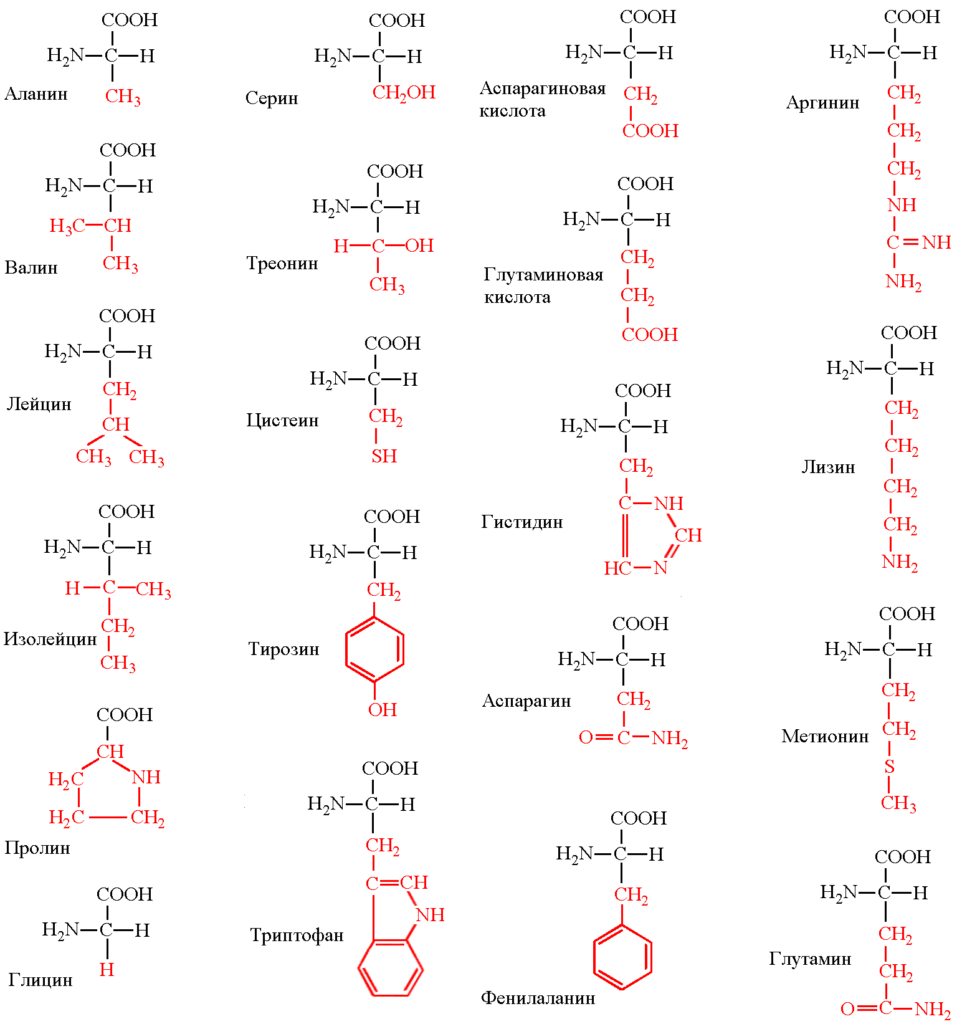
  5. R-group (side chain):
    • It is a unique part of an amino acid that distinguishes one amino acid from another.
    • The R-group can be simple (like glycine, where it is just a hydrogen atom) or complex (like arginine, where it is a long carbon chain with additional functional groups).
    • The properties of the R-group determine the chemical and physical characteristics of the amino acid (for example, hydrophobicity, hydrophilicity, charge).

General Amino Acid Formula:

  • H is hydrogen.
  • nh₂ is an amino group.
  • COOH is a carboxyl group.
  • R — side chain (variable part).

Classification of amino acids:

Amino acids are classified according to the properties of their R-groups:

  1. Nonpolar (hydrophobic):
    • Examples: alanine, valine, leucine, isoleucine.
    • These amino acids are poorly soluble in water.
  2. Polar uncharged:
    • Examples: serine, threonine, asparagine, glutamine.
    • These amino acids have polar side chains, but do not carry a charge.
  3. Charged (acidic and basic):
    • Acidic: aspartic acid, glutamic acid (have a negative charge).
    • Basic: lysine, arginine, histidine (have a positive charge).
  4. Aromatic products:
    • Examples: phenylalanine, tyrosine, tryptophan.
    • These amino acids contain aromatic rings in their side chains.

The role of amino acids in the body:

  1. Protein Synthesis: Amino acids are linked in chains through peptide bonds to form proteins.
  2. Metabolism: Some amino acids are involved in the synthesis of other important molecules, such as neurotransmitters (eg, glutamate, GABA).
  3. Energy metabolism: Amino acids can be used as a source of energy during digestion.
  4. Signaling: Some amino acids (such as glycine, glutamate) function as neurotransmitters.

Conclusion

Amino acids are fundamental molecules consisting of an amino group, a carboxyl group, hydrogen, and a unique side chain (R-group). Their diversity and properties determine their role in protein construction and other biological processes. Understanding the structure of amino acids helps to understand their functions and significance for life.